Star Wars: What Jawas Look Like Under Their Hoods
 Christopher Ramos
 Jawas have never been seen without their hooded robes in the Star Wars universe, but Legends has given fans insight into their rumored appearance.
This article contains spoilers for The Book of Boba Fett episode 5.
Jawas have been around since Star Wars debuted in 1977, but fans have never seen what the small creatures look like under their hooded robes. The meter-tall sentient species was first seen in George Lucas' A New Hope but they've appeared in several other Skywalker Saga installments. More recently, Jawas have been featured on Disney+'s The Mandalorian, coming into contact with the titular figure, Din Djarin. Like Din, Jawas make it an effort never to show their faces, but Legends material, as well as visual depictions, have solved some of the ongoing mystery.
Jawas are known for their long brown robes, featuring just their glowing eyes peeking out from their hoods. Native to desert planets like Tatooine, the scavengers travel the land in Sandcrawlers to scavenge for supplies. In A New Hope, a group of Jawas sold C-3PO and R2-D2 to Owen Lars and Luke Skywalker. The greedy little species often looted ships for scraps, causing trouble for Din Djarin in The Mandalorian season 1; they raided his ship, the Razor Crest, and he was forced to acquire a special "Egg" from a Mudhorn in order to get them back. Jawas have later turned up in The Book of Boba Fett, which is set in Tatooine and consequently features a number of appearances from the small aliens.
While they have been presented as humanoids, what the Jawas look like under their hoods has never been shown in live-action. The best description of Jawas was in the old Star Wars Expanded Universe — specifically in Alan Dean Foster's novelization of the first film. This claimed Jawas "had never been seen outside of their protective cloaks and sandmasks, so no one knew exactly what they looked like," before referring to them as "extraordinarily ugly." They were also believed to be rodent-like devolved humans that carried a very potent smell. In addition, they use orange or yellow-ish gemstones to protect their sensitive eyes from sunlight (giving off the appearance of glowing eyes). Rumors also suggested that Jawas were distantly related to fellow desert-dwellers, Tusken Raiders, sharing a common ancestor, known as the Kumumgah. All this was branded non-canon after Disney acquired Lucasfilm in 2012, though, so it may not be accurate any longer.
What Jawas Look Like Under Their Hoods – All Canon Hints
Lucasfilm's Disney+ TV shows have returned to Tatooine in The Mandalorian and The Book of Boba Fett, with Jawas playing a prominent role. The diminutive creatures have been less developed than the Tuskens, but The Book of Boba Fett episode 5 nonetheless broke new ground in treating Jawas as individuals; Peli Motto claimed she had once dated a Jawa, suggesting they don't keep themselves to themselves quite as much as they did in the Expanded Universe. According to Peli Motto, Jawas are "kinda furry;" in Chuck Wendig's novel Aftermath, a gangster named Adwin Charu claimed Jawas have a musky, animal odor that's reminiscent of a colony of wet rats. All this corresponds rather well to the traditional idea that Jawas are evolved from rodents, suggesting Jawas like quite rat-like; it's worth noting there's no evidence they share a common ancestor with the Tusken Raiders in canon.
Visual Depictions Of Jawas Without Hooded Robes
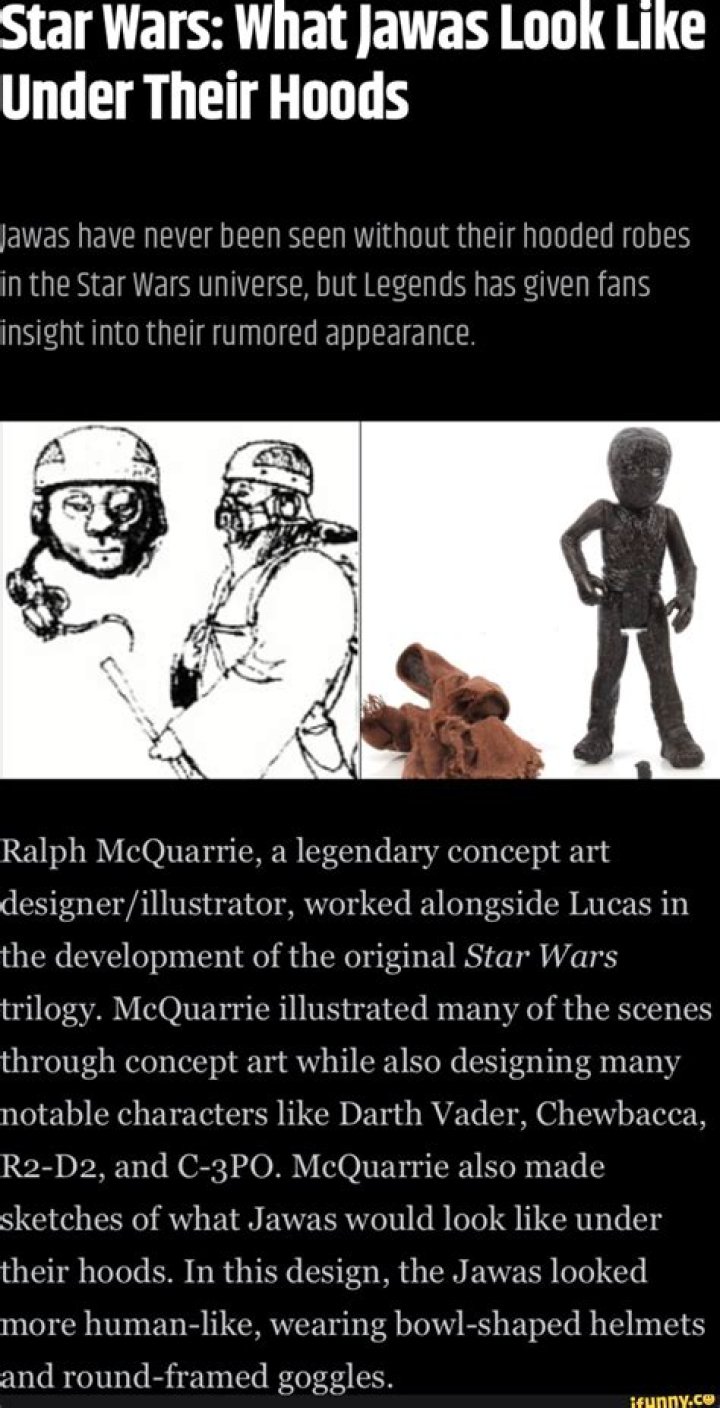
Ralph McQuarrie, a legendary concept art designer/illustrator, worked alongside Lucas in the development of the original Star Wars trilogy. McQuarrie illustrated many of the scenes through concept art while also designing many notable characters like Darth Vader, Chewbacca, R2-D2, and C-3PO. McQuarrie also made sketches of what Jawas would look like under their hoods. In this design, which can be found on Instagram, the Jawas looked more human-like, wearing bowl-shaped helmets and round-framed goggles.
A recently released Star Wars toy gave fans a horrifying look (via Twitter) at Jawas without robes, which matched more of what Foster's novel described. Their appearance looked more creature-like with dark textures of skin or fur, linking to the rodent interpretation — and fitting with Peli Motto's comment that Jawas are furry. The undressed toy was more like a thing of nightmares rather than a revealing look into the anatomy of ambiguous species. Star Wars may never directly confirm what's under a Jawa's robe, but maybe that's for the best based on previous unsettling indicators.
Next: Star Wars Makes A New Hope Deleted Scene Canon After 44 Years
The Book of Boba Fett releases episodes weekly on Disney+